
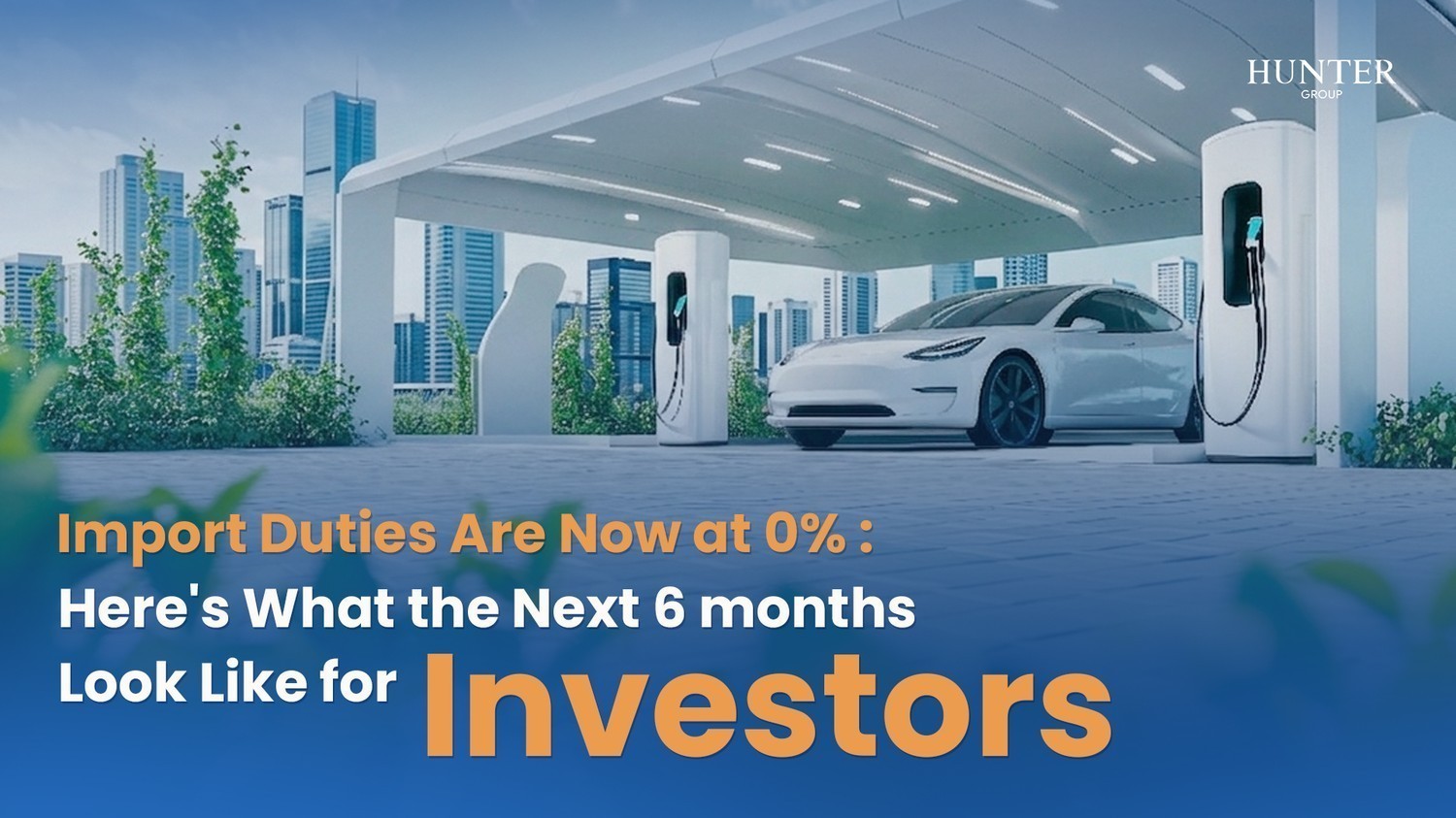
Import Duties Are Now at 0%: Here's What the Next 6 Months Look Like for Investors
For years, the conversation around electric vehicles in Cambodia was a quiet one, whispered in policy rooms. However, on April 1, that quiet gave way to momentum. By cutting EV import taxes from 35% to 0%, the government did more than revise a line in the budget. It’s going to shape Cambodia’s mobility future.
Currently, Cambodia has over 16,000 registered electric vehicles, including more than 11,656 cars, 3,832 motorcycles, and 722 three-wheelers, with 1,676 units registered in March of 2026 alone, according to the Ministry of Public Works and Transport.
And the next 3 to 6 months won't just bring new cars; they will bring a structural transformation of our streets and our economy.
From Policy to Pavement: The Power Transformation
Imagine the streets of Siem Reap or Phnom Penh six months from now. The change won't just be felt in the air—it will be seen in the numbers. As the duty tax vanishes, we are entering a season of rapid evolution:
• Market Price Recalibration: With a reduction in total landed costs, EVs are entering a more competitive price band across both two-wheelers and four-wheelers. Entry-level e-motor prices start at $849- $3,500, while mainstream EV cars are increasingly falling within the $16,000 to $40,000 bracket, depending on model and specifications. This shift makes electric mobility more accessible to a broader base of consumers
• A New Real Estate Math: We are seeing the rise of land grabbing for the electric age. The most valuable plots in the country are no longer just about foot traffic; they are about proximity to power. Investors are already scouting large sites near high-voltage lines, securing the refueling stations of the next decade.
• The Diversity of the Fleet: The streets are already getting more colorful. We can expect an influx of different EV brands and electric tricycles, vehicles designed specifically for families and the bustling markets of Cambodia, filling the gap left by traditional combustion engines. Brands such as BYD, AVATR, and Changan are already filling the market gap left by traditional vehicles.
Beyond the Trend: Powering Cambodia’s New Mobility Era
This isn't a passing trend; it is an intentional evolution. With the government aiming for 770,000 units with around 30,000 cars by 2030, this is a target for mass adoption. Cambodia is betting on a future where sustainability and profit live in the same house.
For investors, this 0% window offers a rare first-mover opportunity. The real returns aren't just in selling vehicles, but in building the world that supports them:
• The Power Grid of Tomorrow: Investing in fast-charging infrastructure that turns a 20-minute wait into a convenient experience, along with a resting area and café. Currently, Cambodia has over 200 fast-charging stations nationwide, with both the government and private sectors aiming to launch hundreds of new charging stations in 2026.
• The Specialized Maintenance: Establishing specialized service centers for the complex thermal and battery systems that traditional mechanics aren't yet equipped to handle.
• Component Supply Chains: There is a growing opening for the local assembly or distribution of EV parts—specifically tires optimized for heavier EV weights and climate-specific cooling components, reducing the reliance on high-cost international shipping.
• The Logistics Leap: Transitioning delivery fleets to e-motorbikes or EV cars, capturing the 70% fuel-saving benchmark that transforms a company's bottom line.
Conclusion
The 0% import tax is more than a policy shift. It is the trigger point of a market revaluation.
The next six months will not reward those who wait for full certainty. They will reward those who recognize that the infrastructure, behavior, and economics of mobility are already shifting beneath the surface.
Cambodia’s EV transition is no longer approaching. It is arriving through ports, entering streets, and beginning to reshape investment logic in real time.
At Hunter Group, we believe the most valuable positions are taken before consensus forms. In this cycle, the advantage will not come from reacting to adoption, but from enabling it.
The future of mobility in Cambodia has already begun. The only question now is who moves early enough to shape it.