
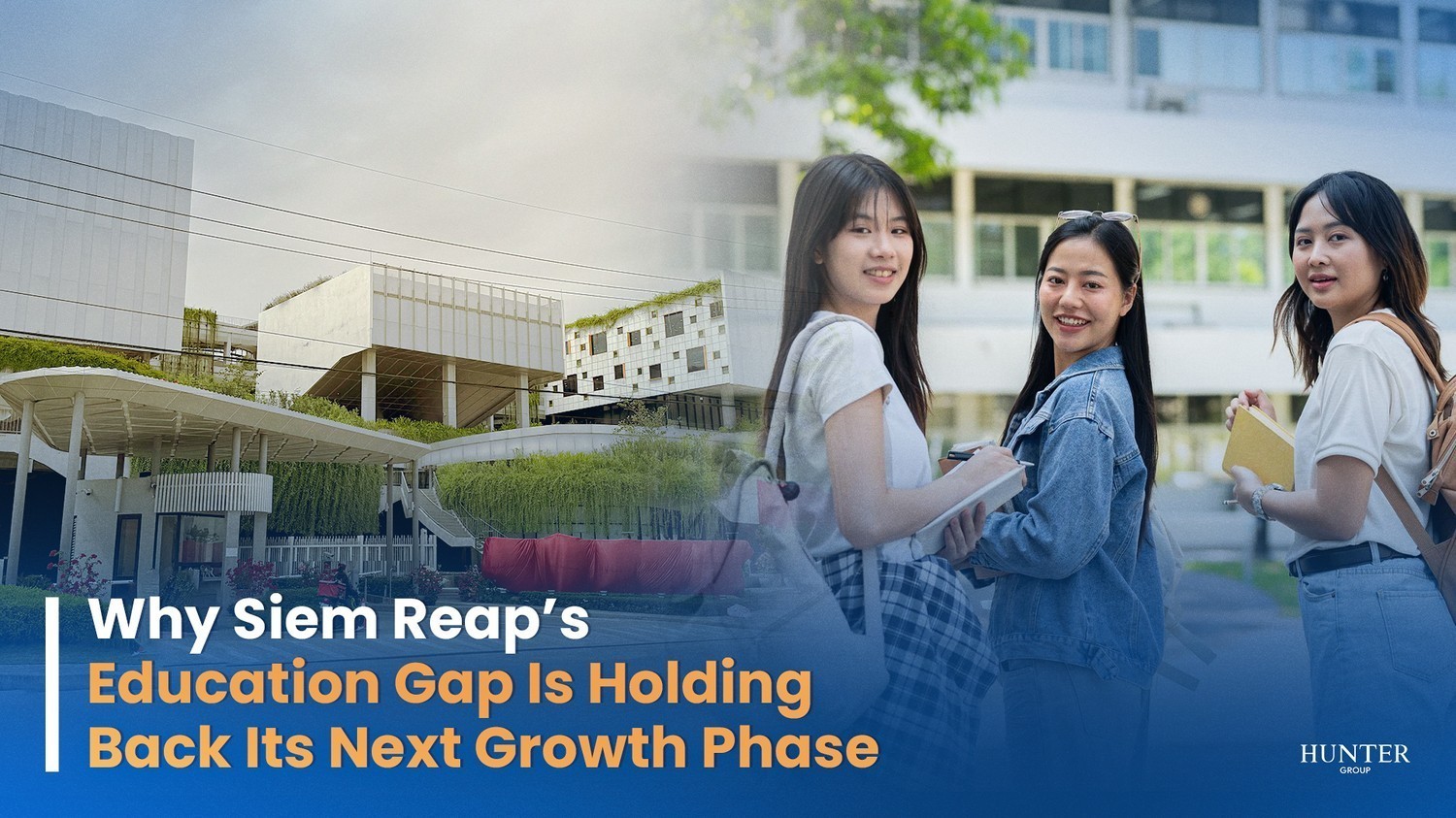
Why Siem Reap’s Education Gap Is Holding Back Its Next Growth Phase
Siem Reap is experiencing a persistent outflow of post-secondary students. Each year, a significant share of 12th-grade graduates leave the city to pursue higher education in Phnom Penh or abroad, primarily due to the limited availability of relevant majors and professional training locally. This is not an isolated preference, but a recurring pattern that reflects a structural gap between youth aspirations and the city’s education offerings.
Why Are Students Leaving Siem Reap?
For decades, Siem Reap’s economic model was anchored almost entirely in tourism and hospitality. Educational institutions evolved accordingly. Universities and training centers prioritized service-oriented disciplines, producing a workforce well-suited to the hospitality sector. Institutions such as École d’Hôtellerie et de Tourisme Paul Dubrule, Sala Bai Hotel & Restaurant School, and SPOONS Cambodia have played a crucial role in developing this talent base.
However, as economic aspirations broadened, the supply did not evolve at the same pace. For families seeking pathways in engineering, medicine, pharmacy, technology, design, or applied sciences, local options remained limited. As a result, outward student migration became the default solution.
According to the Ministry of Tourism, in 2025, 84.5% of Grade 12 students nationwide passed the BACII examination, an increase from 79% in 2024. While Phnom Penh recorded the highest number of A-grade students, Siem Reap ranked among the top provinces with 247 A-grade students. Each year, a growing pool of academically capable students completes high school in Siem Reap, yet the city lacks sufficient higher education pathways to retain them.
Education Remains an Underdeveloped Growth Pillar
Cambodia’s tertiary enrollment rate stood at approximately 17.97% in 2023, with national targets to exceed 22% by 2028 and reach 25% by 2030, according to CEIC Data. Despite this upward trajectory, higher-quality and diversified tertiary institutions remain heavily concentrated in Phnom Penh.
Siem Reap, despite its economic significance and expanding youth population, continues to offer a limited range of post-secondary options, particularly in future-oriented fields. While the city’s economic base is gradually diversifying, education infrastructure has remained largely aligned with an earlier, tourism-centric model.
The Long-Term Cost of Talent Outflow
Student migration has long-term implications for local development. Graduates who leave for higher education often establish careers elsewhere, reducing the likelihood of return. Over time, this has contributed to persistent skill shortages in digital, technical, and creative fields.
Local businesses face constraints in scaling due to limited access to qualified talent. Emerging sectors struggle to mature. Even core functions such as marketing, data operations, and technical support remain difficult to staff consistently.
Siem Reap is no longer defined solely by tourism. While hospitality remains important, economic activity is expanding into digital services, creative industries, modern retail, mixed-use developments, and experience-based enterprises. This transition has exposed a critical imbalance. The city’s economic structure is evolving, but its education system has not yet adjusted to support the next phase of growth.
An Opportunity Investors Should Pay Attention To
The education gap in Siem Reap represents one of the city’s most underrecognized growth opportunities.
The city is supported by a consistently growing youth population, rising economic activity, and a middle class that is increasingly prioritizing education as a long-term investment. Siem Reap already attracts students from surrounding provinces such as Banteay Meanchey, Poipet, Battambang, and Kampong Thom, positioning the city as a natural regional education center rather than a purely local market.
Education investment in Siem Reap is not limited to the construction of schools. It plays a structural role in shaping the city’s next phase of development by building a workforce aligned with the needs of a diversifying economy. Opportunities exist across multiple segments, including:
• Modern, well-equipped universities
• Digital skills and technology institutes
• Vocational and technical training centers
• Business and management schools
• Creative and design academies
From a market perspective, education offers stable enrollment cycles, recurring tuition revenue, and demand that remains resilient across economic cycles. This stability is reinforced by national policy direction. The government’s 2024–2028 education reforms emphasize quality and workforce relevance, while Cambodia’s objective to reach upper-middle-income status by 2030 further supports sustained demand for higher-quality education providers.
Where Investors Can Start
Investing in Siem Reap’s education sector does not require a large upfront capital commitment. Development can be executed in phases, allowing investors to begin with core programs and scale as demand grows.
Initial investment typically focuses on four areas: facilities, curriculum development, instructor recruitment, and accreditation. Purpose-built campuses are not required at the entry stage. A leased facility with approximately 20 rooms or more is sufficient to begin operations, significantly lowering initial capital exposure.
Entry barriers remain relatively low due to several structural factors:
• Limited competition among higher education providers
• Strong demand from surrounding provinces
• A high concentration of the youth population
Tuition benchmarks indicate clear revenue potential. Annual university tuition in Siem Reap generally ranges from approximately $600 to over $1,000, depending on the institution:
• Paññāsāstra University of Cambodia: $897–$1,097 per year
• Angkor University: from $800 per year
• University of Southeast Asia: from $750 per year
• Build Bright University of Cambodia: from $600 per year
These figures demonstrate an established pricing floor and confirm market viability for new education-focused investments in Siem Reap.
Risk Assessment
Risks in education investment in Siem Reap are largely structural and manageable. Established institutions face lower challenges, while newer schools may require up to a year to build credibility and attract enrollment. However, these early-stage risks are mitigated by strong, unmet demand and limited competition. Strategic branding and targeted marketing further reduce barriers, making the environment favorable for investors who approach the market with a clear positioning.
Siem Reap’s Next Era Depends on Its Institutions
Siem Reap’s identity is evolving. Beyond its heritage, natural beauty, and hospitality legacy, the city’s growth will increasingly be defined by its human capital. Ambitious youth are ready to contribute, but the infrastructure to support talent development remains insufficient. For investors, education is not merely another sector—it is a strategic lever capable of shaping the city’s long-term economic trajectory and enabling the next phase of development beyond tourism.
By Sreyneth Kem
Project Marketing & Communication