
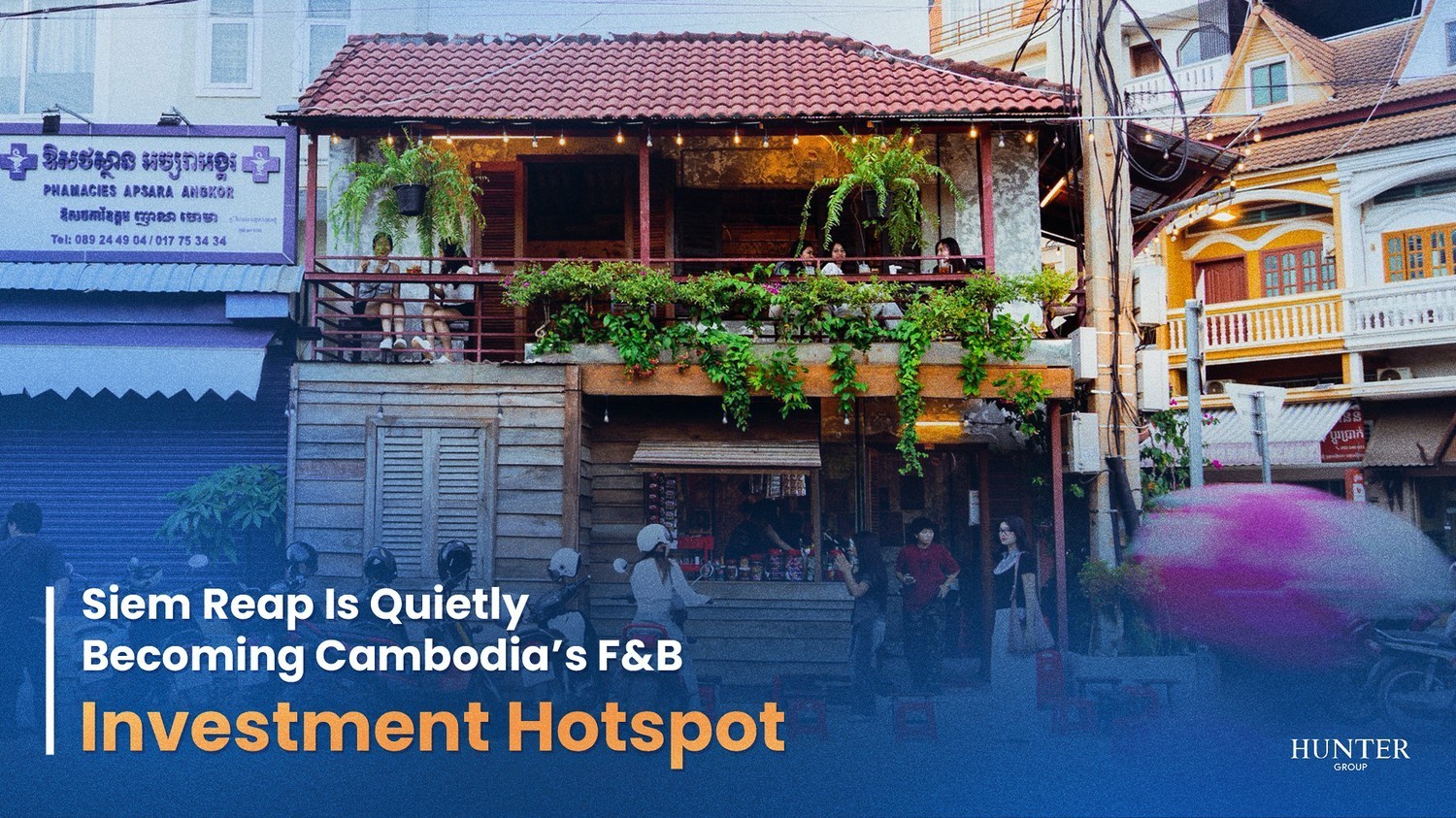
Why Siem Reap Is Quietly Becoming Cambodia’s F&B Investment Hotspot
For decades, Siem Reap has been known primarily for its temples, attracting millions of tourists each year. While tourism has long driven the local economy, the city is now evolving, presenting opportunities beyond its traditional identity.
An Emerging F&B Investment Landscape
The evolution is increasingly visible in the city’s growing F&B landscape. Siem Reap is quietly emerging as a new hotspot for cafés and restaurants. The post-pandemic return of international visitors, increased domestic travel, and social media-driven trends are catalyzing this growth.
Several factors are contributing to this expansion. Improved infrastructure, including the new Siem Reap International Airport, along with evolving travel patterns, has increased both accessibility and demand. Approximately 3.3 million tourists visited Siem Reap in the first 9 months of 2025, nearly 50% jump from 2024, according to the Ministry of Tourism report. Travelers are increasingly seeking authentic, experience-driven activities, which in turn supports the growth of the F&B sector.
The scale of this change is reflected in the latest industry data. In 2025, Siem Reap had approximately 945 restaurants, making it the second city in Cambodia for restaurant density after Phnom Penh, according to experts at Smartscrapers. This expansion reflects the city’s growing economic diversification within the F&B sector.
Experiential Consumption Gains Momentum
Understanding who is driving this growth highlights the market’s potential. Both local and international travelers are seeking intentional experiences that allow them to engage with culture and communities. A McKinsey survey confirms that Gen Z leads this trend, followed by Millennials and Gen X, highlighting sustained demand for experiential dining and café concepts.
For investors, these patterns translate into tangible opportunities. These trends indicate that cafés and restaurants focused on customer experience and engagement are well-positioned to capture market growth. Entering Siem Reap’s F&B sector now aligns with favorable timing and emerging demand patterns.
Budget Planning and Consideration
From an investment perspective, entry barriers remain relatively manageable compared to larger regional cities like Phnom Penh and Sihanoukville. In Siem Reap, the starting capital for mid-range restaurants begins at $10,000, and $5,000 for a café shop with designed seats, based on market observation. The starting cost also depends on size, location, and store concept. A small to mid-sized café targeting tourists, expats, and young locals, key cost components typically include:
• Location rent
• interior fit-out
• Equipment,
• Staffing
• Marketing
Careful budget planning, particularly around rent and renovation costs, plays a critical role in maintaining healthy margins in an increasingly competitive environment. Price for rental property varies depending on the property type, its size, and location, with prices ranging as follows:
• Shophouse: $700-$2500/month
• Retail space: from $400/month
Prime Location for F&B Business
• Sala Kamreuk (specifically wat bo area, along the Achar Sva st, bamboo st): proximity to schools, expats community, residential areas, and hotels.
• Pub street area: high number of foot traffic from both tourists and locals, proximity to hotels, and other entertainment.
• River Road: this area has gained huge popularity, with cafés and restaurants opening one after another in the last several months of 2025. Running along the river, the area offers a fresh, relaxing atmosphere, ideal for visitors looking to cool off during the day.
Business Challenges and Risks
Despite its potential, the Siem Reap F&B market is not without challenges. Broader economic uncertainty and regional geopolitical tensions may affect travel sentiment. On an operational level, rising competition, staffing constraints, and weak brand positioning can impact profitability. Effective marketing, clear concept differentiation, and disciplined cost control are therefore essential for long-term sustainability.
Conclusion
Siem Reap is gradually reshaping its economic identity, evolving from a tourism-dependent city into an emerging lifestyle and investment destination. For investors who approach the F&B sector with realistic expectations, strong market research, and disciplined execution, the city presents a compelling opportunity at an early stage of its growth cycle.