
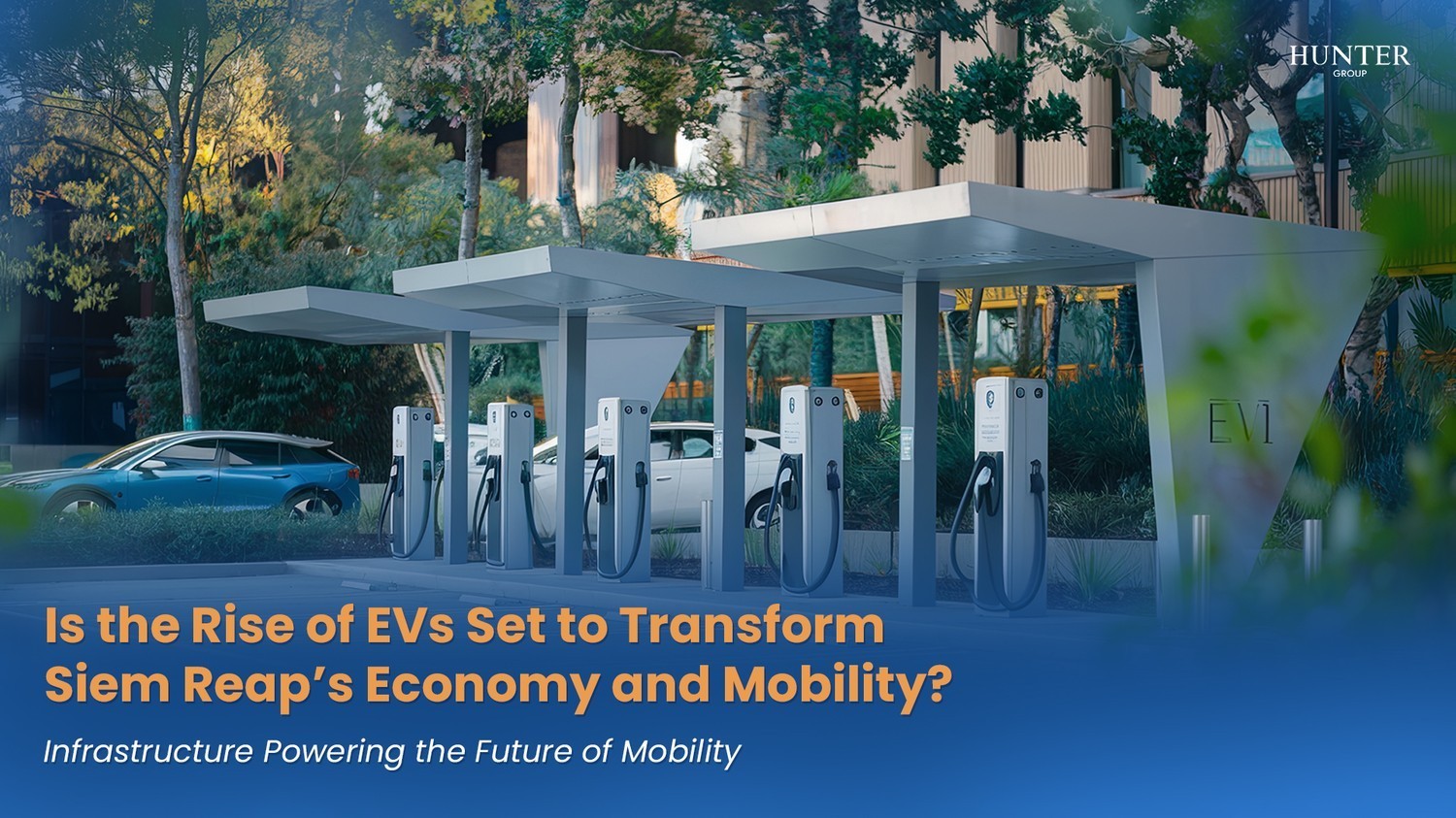
Is the Rise of EVs Set to Transform Siem Reap’s Economy and Mobility?
Siem Reap is evolving fast. Once known primarily as a gateway to world-famous temples, the city is now positioning itself as a hub for lifestyle, sustainability, and forward-looking infrastructure. Tourism is changing too—longer stays, wellness travel, and eco-conscious visitors are reshaping the city’s needs.
Amid this transformation, electric vehicle (EV) charging stations are emerging as a compelling investment opportunity. With EV adoption rising, the need for reliable charging infrastructure is becoming urgent.
EV Adoption Accelerates: The Market Gap Investors Can Fill
The use of EVs in Siem Reap is growing rapidly—from personal vehicles to company fleets. Transportation operators like TADA have been deploying energy-efficient electric tuk-tuks, such as the ONiON T1, since 2022, underscoring businesses' growing preference for greener mobility solutions. Yet the availability of charging stations has not kept pace. For investors, this gap represents a first-mover opportunity in a market poised for rapid expansion.
Why the Demand is Surging
EV adoption is fueled by both consumer behavior and policy drivers. Individuals and companies are motivated by:
• Cost-effectiveness
Price for EV charging ranges from 1,050 riels per kWh for AC (Alternating Charging) to 1,350 riels per kWh for DC (Direct Charging), according to the Electricity Authority of Cambodia (EAC).
• Fuel efficiency
EV cars converts 85% of the energy into motion, while Internal Combustion Engine converts only 20%-30%, which means more energy goes into noise and heat.
• Environmental benefits
When less heat and smoke are generated, less pollution is produced. According to BloombergNEF, electric vehicles emit up to 71% less emissions compared to ICE vehicles.
• Premium experiences
The absence of the combustion engine eliminates noise, offering a quiet and relaxing environment while driving. On top of that, the majority of EV cars allow for pre-heating or cooling their vehicles via a smartphone app without using the driving battery, making it convenient for users.
• Government initiatives
The Royal Government of Cambodia is actively supporting this shift through initiatives, promoting cleaner transport and reducing urban pollution. Charging price deduction, and plans to introduce 3 electric bus lines in Siem Reap further demonstrate a commitment to eco-tourism and a greener urban future.
Data Confirms the Momentum
Market data confirms the momentum. In late 2025, BYD opened its first sales and service center in Siem Reap, reflecting strong local demand. As of August 2025, BYD has a total of 7 showrooms across Cambodia, which the company aims to increase to 13 by late 2025. Nationwide, Cambodia registered 12,968 electric vehicles in 2025, according to the Ministry of Public Works and Transport. Of these, 9,065 were electric cars, while motorcycles and tricycles accounted for 3,203 and 700 units, respectively. These figures align with government targets to increase EV adoption to 35–40% for cars and 70% for motorcycles by 2050, demonstrating both market traction and policy support.
A Multi-Segment Market Seeking Sustainable Solutions
EV charging stations are not just about vehicles; they serve multiple growing markets.
• Young Professionals: Early adopters of modern, cost-effective mobility solutions who are likely to use charging stations regularly.
• Growing Middle-Income Households: Expanding demographic upgrading to electric vehicles for convenience, cost savings, and sustainability.
• Eco-Conscious Travelers: Tourists seeking sustainable, low-impact transport options that align with lifestyle and wellness trends.
• Hospitality & Transport Operators: Hotels, resorts, and transportation companies requiring reliable charging for fleets to enhance guest experience and operational efficiency.
These demand streams make EV charging infrastructure both a consumer and institutional necessity.
Investor Key consideration
EV charging infrastructure in Siem Reap presents a clear first-mover opportunity, allowing investors to capitalize on growing demand before the market catches up. Key considerations for turning this opportunity into action include:
• Strategic Location: Focus on high-traffic areas such as hotels, resorts, mixed-use developments, and popular tourist corridors.
• Technology & Infrastructure: Ensure chargers are compatible with multiple EV models, offer fast-charging options, and explore renewable integration, such as solar power.
• Partnership Opportunities: Collaborate with hotels, resorts, motorbike rental shops, transport operators, and local authorities to secure guaranteed usage.
• Revenue Model: Explore pay-per-use, subscription plans for fleets, and maintenance/service contracts for consistent cash flow.
• Policy Alignment: Leverage government incentives and keep up with EV adoption targets to reduce regulatory risk.
• Operational Planning: Assess grid capacity, installation costs, and ongoing maintenance requirements.
Mitigation Strategies for Investors
Just like any other investment, electric vehicle charging stations present key challenges, including:
• Upfront infrastructure costs
A commercial EV charging setup can range from $120–$150 for a basic 7 kW AC unit to $5,000–$15,000+ for DC fast chargers, with installation and electrical works adding several thousand dollars more.
• Electricity grid capacity limitations
Fast-charging stations often require transformer upgrades or new grid connections, significantly increasing installation costs and extending deployment timelines.
• Policy incentives
Licensed operators can benefit from reduced charging rates and regulatory support that lowers entry barriers
• Pricing
Cambodia’s charging price reduction allows operators to set competitive rates and ensure high profitability.
However, these risks can be mitigated through careful location planning, partnerships with hotels and resorts, and scalable system designs. Early movers who align strategy with trend adoption and government support can minimize risk while tapping into a high-growth opportunity.
At Hunter Group, we work alongside investors to navigate site selection, feasibility assessment, development planning, and market positioning, making entering the Siem Reap market smooth and seamless.
Source:
• Electricity Authority of Cambodia (EAC)
• Elepot
• Cities Development Initiatives for Asia
• Kiripost
• Dgmotorscar
• Market Insight
By Sreyneth Kem
Project Marketing & Communication