
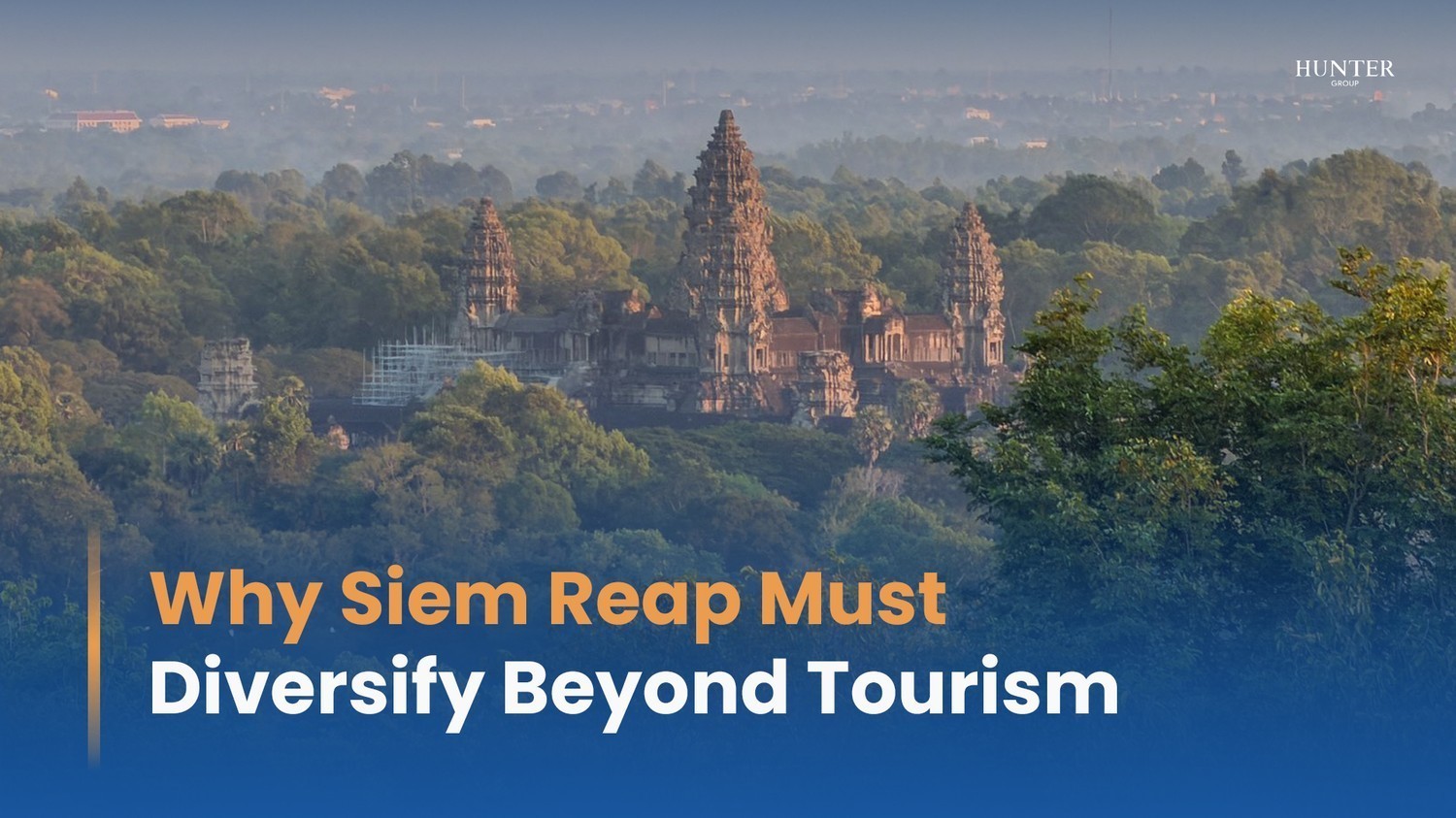
Why Siem Reap Must Diversify Beyond Tourism
For years, Siem Reap has been recognized as Cambodia’s tourism capital, with its economy heavily shaped by hospitality, international visitors, and the global appeal of Angkor Wat. Businesses, careers, and education pathways were largely built around a single industry: tourism.
Before the pandemic, that model appeared highly successful. In 2019, Cambodia welcomed approximately 6.6 million international visitors and generated $4.92 billion in tourism revenue, with tourism contributing more than 12% of the country’s GDP. Siem Reap stood at the center of that growth. However, the COVID-19 pandemic exposed a structural vulnerability that had long been overlooked: what happens when tourism stops?
As borders closed and global travel came to a standstill, the impact on Siem Reap was immediate. Hotels suspended operations, restaurants closed, and tourism-dependent businesses struggled to survive. Streets once filled with international visitors became unusually quiet almost overnight. By 2021, Cambodia’s international tourist arrivals had fallen from 6.6 million to approximately 196,495 visitors, while tourism’s contribution to GDP dropped from over 12% to just 1.8%.
The crisis revealed an important reality. Economies built too heavily around a single industry become highly vulnerable to external shocks. For Siem Reap, the pandemic became more than a temporary disruption. It became a turning point.
A Shift Beyond Tourism
As businesses adapted to survive, the city began moving toward a broader economic model. Many shifted their focus toward domestic travelers, localized services, and more diversified sources of demand rather than relying entirely on seasonal international tourism.
This transition marked the early stages of a larger transformation. Siem Reap was no longer functioning solely as a tourism destination. Gradually, it began evolving into a city attracting long-term residents, entrepreneurs, remote workers, retirees, and returning Cambodians seeking a different lifestyle and pace of living. This shift matters because long-term residents change the structure of local demand.
Unlike short-term tourists, residents create more consistent economic activity across multiple sectors, including housing, healthcare, education, retail, cafés, co-working spaces, and community-driven developments.
As living costs continue rising across larger Southeast Asian cities, Siem Reap’s affordability, safety, slower pace, and improving infrastructure are becoming increasingly attractive to people looking to live, not simply visit.
In many ways, the city is beginning to transition from a visitor economy toward a lifestyle economy.
Building the Workforce for Siem Reap's Next Chapter
As the economy evolves, so do the skills required to support it.
Businesses today are increasingly looking beyond traditional hospitality roles. Demand is growing for digital marketers, software developers, architects, engineers, financial analysts, healthcare professionals, project managers, and urban planners capable of supporting a more diversified and modern economy.
However, much of Siem Reap’s workforce has historically been trained primarily for the tourism and hospitality sectors. While those industries remain important, the city now faces a growing gap in technical and professional talent needed to support long-term economic expansion. This challenge extends beyond employment alone. Talent plays a critical role in shaping urban competitiveness. Cities that successfully attract and retain skilled professionals often develop stronger business ecosystems, more resilient industries, higher-value economic activity, and greater long-term investment confidence.
For Siem Reap, diversification may depend not only on infrastructure or tourism recovery, but on whether the city can create enough opportunities for skilled people to build long-term careers locally.
Infrastructure Is Accelerating the Transition
At the same time, infrastructure development is helping accelerate the city’s transformation.
The new Siem Reap Angkor International Airport, expanding road connectivity, and ongoing urban development are improving accessibility and supporting broader economic activity beyond tourism alone.
These developments are gradually repositioning Siem Reap as more than a seasonal destination. They are helping create the foundation for long-term urban growth.
As demographic patterns evolve and more residents choose to stay long-term, investment demand is also beginning to shift.
Why Investors Are Paying Attention
Tourism will likely remain one of Siem Reap’s most important economic pillars. However, future growth opportunities may increasingly emerge from sectors supported by long-term residency and urban expansion rather than tourism alone. This includes growing demand for:
• Residential developments
• Mixed-use commercial projects
• Education and training centers
• Healthcare facilities
• Creative and technology-related industries
• Co-working and community-focused spaces
For investors, this transition signals something larger than short-term tourism recovery. It reflects the early stages of a broader urban evolution.
Compared to larger regional cities, Siem Reap still offers relatively accessible entry costs while benefiting from improving infrastructure, increasing urban development, and changing demographic trends. As the city continues diversifying, the economy may become more stable, less seasonal, and less dependent on external tourism cycles.
The Road Ahead
Despite the opportunities, challenges remain. Tourism recovery continues unevenly, some sectors still face oversupply after years of tourism-focused development, and regional competition remains strong. At the same time, many skilled young professionals continue relocating to Phnom Penh or overseas markets in search of higher salaries and stronger career opportunities.
This may ultimately become one of Siem Reap’s defining challenges.
The city’s long-term competitiveness may depend not only on attracting visitors, but on its ability to attract and retain the people capable of building its next economy.
Tourism helped shape Siem Reap’s identity for decades. But diversification may determine the strength and resilience of its future.